

Boston rewards the wanderer. Compact, walkable and steeped in history, it’s a place where you can trace the nation’s early footsteps while discovering a vibrant modern scene just steps away. From the waterfront to the North End to Back Bay, every neighborhood feels like a new chapter in a story that’s still being written.
Begin at the Boston Tea Party Ships & Museum, where costumed historians bring the Revolutionary era to life. Visitors can toss replica tea crates into the harbor and tour restored ships that mark the moment colonial protest ignited into revolution. Just outside, the Harborwalk stretches along the waterfront, connecting the Tea Party site to the Seaport District, a gleaming modern neighborhood filled with trendy restaurants, rooftop bars and public art installations. Grab a lobster roll at Legal Sea Foods Harborside or watch sailboats drift by from Lookout Rooftop Bar & Lounge, a reminder that Boston’s maritime past still shapes its present.


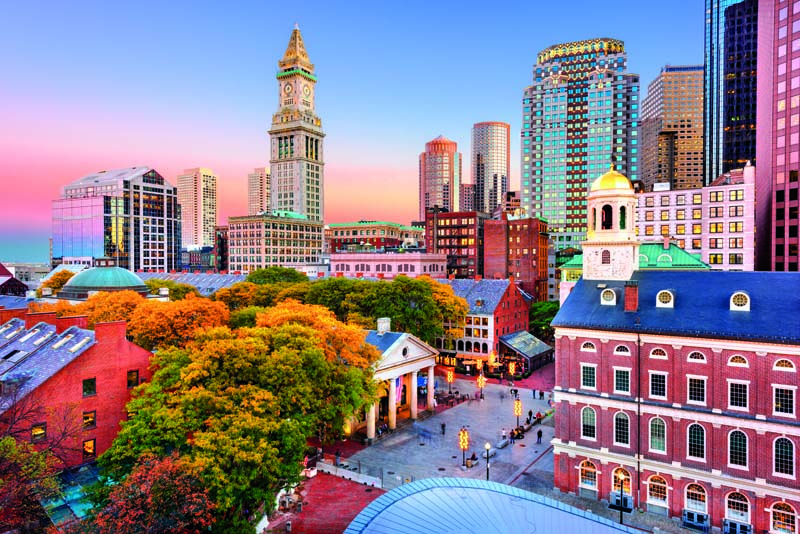
A short walk inland takes you to Faneuil Hall, built in 1742 and known as the “Cradle of Liberty” for its role in America’s early political debates. Today, it remains a popular gathering place, anchored by Quincy Market, where local vendors dish out everything from clam chowder in bread bowls to New England whoopie pies. Street performers entertain crowds in the open-air courtyard, adding to the lively atmosphere that’s distinctly Boston.
Just beyond lies the Freedom Trail, a red-brick path weaving through 2.5 miles of landmarks that define the American Revolution. Along the way, visitors encounter the Old South Meeting House, where colonists planned the Tea Party, King’s Chapel and its historic burying ground, and the Granary Burying Ground, the final resting place of Paul Revere, John Hancock and Samuel Adams.
Follow the trail north into the North End, Boston’s oldest residential neighborhood and its Little Italy. Narrow streets hum with conversation and the smell of garlic and fresh bread. Stop at Paul Revere’s House, the city’s oldest structure, and the Old North Church, where lanterns signaled the approach of British troops: one if by land, two if by sea. Afterward, grab cannolis at Mike’s Pastry or Modern Pastry, both claiming to be the city’s best. Nearby, the Copp’s Hill Burying Ground offers a quiet moment above the harbor, surrounded by centuries-old headstones etched with history.
From there, head west through Beacon Hill, one of Boston’s most photographed neighborhoods. Gas lamps line narrow brick sidewalks and flower boxes decorate Federal-style rowhouses. Charles Street’s boutiques and cafés invite lingering, while the Boston Common and Public Garden, America’s oldest public parks, offer open green spaces for a rest. The lagoon in the Public Garden, with its famous Swan Boats, has been delighting visitors since the 1870s.
Continue toward Back Bay, where 19th-century brownstones line elegant avenues like Commonwealth Avenue and Marlborough Street. Once a tidal marsh, the area was transformed into one of Boston’s most desirable neighborhoods. Here, Newbury Street offers eight blocks of shopping, dining and galleries, from luxury brands to cozy coffee shops. Stop for oysters at Select Oyster Bar or a glass of wine at Stephanie’s on Newbury before walking to the Boston Public Library, a Renaissance-style masterpiece that’s free to explore.
No trip is complete without a stop at Copley Square, framed by the architectural contrast of Trinity Church, the John Hancock Tower and the Fairmont Copley Plaza Hotel. From there, it’s an easy stroll across the Charles River Esplanade, where runners, bikers and families gather to watch the sunset over the skyline.
Boston isn’t just a city to see; it’s one to feel. Its stories live in every cobblestone, its progress shines in every skyline reflection and its charm lingers long after you’ve left. Whether you’re standing where the Revolution began, sipping coffee on Newbury Street or watching Swan Boats glide by, Boston proves that the best way to experience history is to walk right through it.


